Emergency Commercial Cleaning: The Business Owner’s Rapid Response Checklist
Imagine arriving at your Perth CBD office on a Monday morning only to find a burst pipe has flooded your entire reception area. Every minute the doors stay closed, your revenue drops and your professional reputation takes a hit. Dealing with a sudden crisis is incredibly stressful for any business owner; you're likely worried about staff safety, Western Australian health and safety compliance, and the mounting cost of downtime. You need emergency commercial cleaning that doesn't just mop up the mess but restores your site to professional standards immediately.
We understand that when disaster strikes, you need a response that is as fast as it is thorough. This guide will show you how to manage a cleaning crisis with precision and provide a comprehensive checklist to get your operations back on track without delay. We will walk you through the essential steps to identify hazards, secure your site, and connect with vetted professionals who can handle high-stakes environments. You'll learn how to navigate a cleanup while remaining compliant with Australian standards, giving you the peace of mind that your workspace is fully decontaminated and ready for business.
Key Takeaways
- Learn the critical steps to take in the first 60 minutes of a crisis to protect your team and secure your premises.
- Understand the difference between standard urgent requests and emergency commercial cleaning to ensure you get the right level of specialised care.
- Master the documentation process for insurance claims to help recover costs and reduce business downtime.
- Use our detailed structural and hygiene checklist to confirm your site is fully decontaminated and safe for staff to return.
- Discover how to use modern digital tools to find reliable, vetted cleaners in Perth without the stress of long-term contracts.
Table of Contents
- Understanding Emergency Commercial Cleaning: When to Call the Professionals
- The First 60 Minutes: Immediate Actions Before Your Cleaners Arrive
- Evaluating the Crisis: Urgent vs. Emergency Cleaning Requirements
- The Comprehensive Emergency Commercial Cleaning Checklist
- How the Deep Clean App Streamlines Crisis Management in WA
Understanding Emergency Commercial Cleaning: When to Call the Professionals
Emergency commercial cleaning is a specialised service designed to handle incidents that threaten your business's safety, health compliance, or ability to operate. It's different from your standard nightly vacuum and dust. A true cleaning emergency involves risks that your regular team isn't equipped to manage, such as biohazards, major water ingress, or hazardous soot. In Perth, we often see these crises manifest as burst pipes in CBD offices or viral outbreaks in busy childcare centres. These aren't just messes; they're operational stoppages that require immediate intervention.
The cost of delay is often much higher than the price of the clean itself. For example, water sitting in a carpet for more than 24 hours can lead to permanent structural damage and the growth of toxic mould. While regular janitorial staff help maintain Commercial cleaning industry standards, they usually lack the industrial water extractors or the P2/N95 respiratory gear required for safe, high-intensity decontamination. Professional emergency teams bring the right equipment to ensure the site is restored quickly and safely.
Identifying High-Risk Cleaning Scenarios
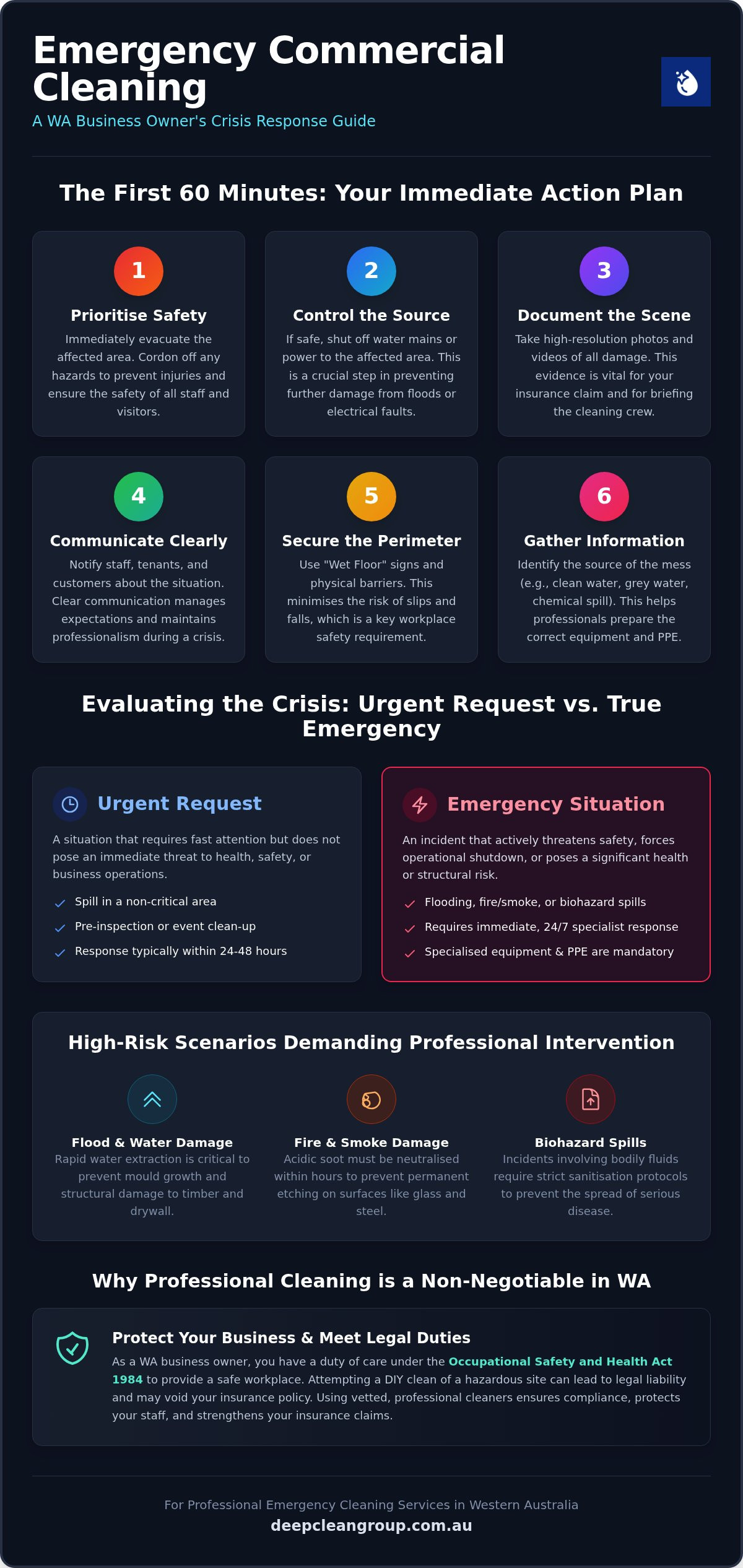
Specific situations demand a rapid response from vetted professionals. Biohazard spills involving bodily fluids in medical clinics or childcare centres in Joondalup require strict sanitisation to prevent the spread of disease. Flood damage after a WA winter storm is another common trigger. Without rapid extraction, water can seep into structural timber and drywall, leading to long-term instability. Fire and smoke damage also fall into this category. Soot is highly acidic and can permanently etch surfaces like glass and stainless steel if it isn't neutralised within hours of the incident.
The Legal and Safety Implications for WA Business Owners
Business owners in Western Australia must navigate strict legal requirements. Under the Occupational Safety and Health Act 1984, you have a clear duty of care to provide a safe workplace. If you attempt a DIY clean of a hazardous site, you risk more than just your health. Many insurance providers in Australia will deny claims if they find that professional decontamination protocols weren't followed. Using vetted cleaners ensures your business remains compliant with Australian health and safety standards, protecting your liability and giving your staff in locations like Fremantle or Mandurah the confidence to return to work.
The First 60 Minutes: Immediate Actions Before Your Cleaners Arrive
The first hour following a facility crisis is the most critical window for damage control. Your immediate response determines whether you'll be closed for a day or a week. Start by prioritising human safety; evacuate the affected zone and cordon off hazards to prevent secondary injuries. If you are dealing with a burst pipe or an electrical issue, turn off the water or power mains only if it is safe to do so. Once the area is stable, begin documenting the scene. Take high-resolution photos and videos of all damage. This evidence is essential for Australian insurance providers and helps your emergency commercial cleaning team prepare the right equipment.
Communication is your next priority. Notify your staff, tenants, and customers about the temporary closure as soon as possible. Clear communication manages expectations and reduces the volume of enquiries while you're busy managing the site. If you need help fast, booking an Urgent & Last-minute Clean allows you to bypass long wait times and get professional boots on the ground quickly.
Securing the Perimeter and Assessing Risks
Place "Wet Floor" signage and physical barriers around the site to prevent slips and falls. This is particularly important in high-traffic areas like retail centres in Rockingham or office lobbies in the Perth CBD. Try to identify any unknown substances from a safe distance. Knowing if a spill is chemical or biological helps the cleaning crew bring the correct Personal Protective Equipment (PPE). Maintaining high standards often involves following CDC environmental cleaning guidelines to ensure pathogens are handled correctly. Finally, ensure the entry point is clear of debris so the team can move their industrial machinery inside without delay.
Information Gathering for a Faster Clean
Gathering specific details can shave hours off the restoration process. Identify the source of the mess; for example, is it grey water from a dishwasher or black water from a sewage backup? Black water requires significantly more aggressive sanitisation. Locate the nearest power points and water taps for the cleaning team to use. If the incident happens after-hours, have site access codes or keys ready. Providing this information upfront ensures the technicians can start work the moment they arrive at your Mandurah or Joondalup facility, moving you closer to a full recovery.
Evaluating the Crisis: Urgent vs. Emergency Cleaning Requirements
Categorising your situation correctly is the first step toward a successful resolution. While it's tempting to label every surprise as a crisis, true emergency commercial cleaning is specifically for incidents that threaten health, safety, or structural integrity. An urgent clean is often a matter of convenience or professional appearance, like a last-minute spruce up before an unexpected inspection. On the other hand, an emergency requires a different class of vetted professional equipped with industrial grade tools. In Perth and surrounding hubs like Joondalup, knowing which tier your situation falls into helps you secure the right level of help without unnecessary delays.
Resource allocation is the main reason this distinction matters. A standard cleaning crew may be able to handle an urgent request if they have a gap in their schedule. However, emergency commercial cleaning requires technicians who are trained in rapid sanitisation and hazard containment. These professionals are often on standby to deploy specialised equipment, such as high-capacity dehumidifiers or HEPA-filtered vacuums, which aren't found in a typical janitorial cupboard. Choosing the wrong tier of service can result in a response that is too slow or under-equipped for the task at hand.
Comparing Response Tiers and Service Levels
Response times across Western Australia vary based on the severity of the incident. We typically categorise these into three distinct levels:
- Tier 1: Emergency. This involves an immediate threat like a sewage backflow, a significant chemical spill, or flood damage. Technicians aim for a 1 to 4 hour response time to mitigate damage and secure the site.
- Tier 2: Urgent. These are critical operational needs that don't pose a safety risk, such as preparing a medical centre for a sudden audit. These are usually handled with same-day or next-day bookings.
- Tier 3: Specialised. These are planned deep cleans where speed is less critical than precision. Examples include end-of-lease requirements or scheduled carpet steam cleaning.
Chemicals and Standards (AS 3780.1)
When a crisis hits, supermarket grade sprays won't provide the level of decontamination required. Professional teams use hospital grade disinfectants that are TGA-listed to kill specific pathogens. Following Australian standards for chemical handling, such as AS 3780.1, is non-negotiable for commercial sites. This standard governs the storage and handling of corrosive substances, ensuring that the cleanup process doesn't create a new set of hazards for your staff. Vetted professionals understand these regulations and will provide a Safety Data Sheet (SDS) for every product used on your site. This documentation is vital for your health and safety records and ensures your facility meets the highest sanitisation benchmarks.
The Comprehensive Emergency Commercial Cleaning Checklist
Restoring your facility requires a methodical approach that leaves no room for error. A professional emergency commercial cleaning protocol ensures that every surface is not just visibly clean, but safe for re-entry. We break this down into four critical categories to ensure your Perth business meets every safety and hygiene benchmark. Following a structured process helps you avoid missed spots that could lead to long-term issues like mould or recurring odours.
- Structural Checklist: Inspect walls for bubbling paint, ceilings for sagging or water spots, and flooring for warping, lifting, or damp patches.
- Hygiene Checklist: Sanitise all high-touch points like elevator buttons, door handles, and communal kitchen surfaces. Deploy air scrubbers to remove airborne contaminants or lingering odours.
- Safety Checklist: Clear all debris and ensure floors are completely dry to verify slip-resistance. Check for exposed wiring or damaged electrical sockets that may have been affected by the incident.
- Compliance Checklist: Dispose of contaminated waste according to Western Australian environmental regulations and obtain a final site sign-off for your records.
Area-Specific Cleaning Protocols
Different environments in Western Australia require tailored solutions. For office spaces in the Perth CBD, the focus shifts to protecting sensitive technology and vital paper documents from soot or water damage. In medical centres or childcare facilities in Joondalup, the protocol is much more stringent. Every toy, bed, and piece of clinical equipment must undergo deep disinfection using hospital-grade products to prevent cross-contamination. For industrial sites and warehouses in Rockingham or Fremantle, the priority is heavy-duty degreasing and managing large-scale waste to keep the production line moving safely.
Final Inspection and Handover
Before you allow staff or customers back inside, perform a final "White Glove" test. This involves a meticulous walkthrough to ensure no residue, dust, or odours remain in the affected area. You should also obtain a cleaning certificate from your provider. This document is essential for health inspectors, insurance adjusters, or landlords to prove the site was professionally decontaminated. Finally, restock any hygiene supplies like hand sanitiser, soap, or paper towels that were consumed during the cleanup process. To ensure your site meets these high standards without the stress of long-term contracts, book your Offices, Medical & Childcare Centres Cleaning through our vetted network today.
How the Deep Clean App Streamlines Crisis Management in WA
Speed is the most valuable currency when your business is underwater or facing a biohazard. Traditional cleaning models rely on a "quote-and-wait" cycle that can take hours or even days. In an emergency commercial cleaning scenario, this delay is unacceptable. Deep Clean Group's mobile app bypasses these friction points by connecting you directly with vetted professionals who are ready to deploy. You don't have to worry about the reliability of the person entering your site; every cleaner is thoroughly screened to meet the high standards required for medical centres, childcare facilities, and corporate offices.
Flexibility is another core pillar of modern crisis management. Most commercial cleaning contracts lock you into long-term commitments that don't account for sudden incidents. Deep Clean Group offers a "get-it-done" solution with no lock-in contracts. This means you can get the help you need in the moment without being tethered to a service you don't require daily. Whether you're in the heart of the Perth CBD or operating a warehouse in Fremantle, you have access to local expertise that understands Western Australian safety regulations and site requirements.
The Technology Behind the Response
Digital tools remove the guesswork from restoration. You can track your cleaning team's arrival in real-time, which allows you to coordinate with other contractors or staff on-site more effectively. Once the job is finished, the Deep Clean Group platform provides digital documentation and reporting. Having clear proof of professional decontamination is vital for insurance claims and health inspections. Payments and invoicing are handled seamlessly within the Deep Clean Group marketplace, so you can focus on reopening your doors rather than chasing paperwork.
Building a Resilient Business in Western Australia
Resilience isn't just about how you react; it's about how you prepare. Having the Deep Clean Group app on your phone is a low-cost, high-impact part of any disaster recovery plan. It ensures that when a pipe bursts or a storm hits, you aren't scrambling for a phone book. You're supporting independent WA cleaners while receiving a premium, tech-driven service that prioritises your business's uptime. Don't wait for a crisis to find your solution. Download the Deep Clean Group Mobile App today to connect with independent cleaners and ensure you're prepared for whatever tomorrow brings.
Restoring Your Business with Confidence
Managing a facility crisis requires more than just a quick reaction; it demands a disciplined protocol and the right professional support. By prioritising safety in the first hour and following a structured checklist, you protect your staff and your bottom line from the fallout of unexpected damage. Whether you're dealing with a burst pipe in the Perth CBD or a hygiene breach in a Joondalup childcare centre, having a plan in place is the difference between a minor setback and a major shutdown.
Professional emergency commercial cleaning ensures that your site meets Australian health and safety standards while minimising operational downtime. You can Download the Deep Clean Marketplace App today to connect with vetted independent cleaners who are ready to respond on demand. Our platform is backed by over 20 years of industry experience and offers on-demand booking with no lock-in contracts. This modern approach removes the friction from maintenance, allowing you to focus on what matters most. Stay proactive, keep your business resilient, and know that help is always a few taps away.
Frequently Asked Questions
What qualifies as an emergency commercial cleaning situation?
An emergency situation is defined by an immediate risk to health, safety, or your ability to trade. This includes sewage backups, significant water ingress from storms, or biohazard spills in high-traffic areas. If the incident requires specialised equipment or rapid sanitisation to prevent structural damage or illness, it is a cleaning emergency. These events demand a much faster response than a standard janitorial visit to keep your facility compliant with Australian WHS laws.
How quickly can an emergency cleaner arrive at my Perth business?
Response times vary based on your specific location and the severity of the crisis. For Tier 1 emergency commercial cleaning in the Perth CBD or inner suburbs, technicians typically aim to be on-site within one to four hours. Businesses in outer hubs like Joondalup or Mandurah may see slightly longer travel times. Using a digital marketplace allows you to see real-time availability and track your team's arrival through the mobile app for maximum transparency.
Does insurance typically cover the cost of emergency cleaning?
Most Australian business insurance policies cover professional cleaning costs if the service is required to mitigate further property damage. For instance, rapid water extraction after a burst pipe is often covered to prevent mould growth. You must provide clear evidence, such as photos and a professional cleaning certificate, to support your claim. We recommend checking your specific Product Disclosure Statement (PDS) to confirm your level of cover for specialised decontamination services.
Can I book a last-minute clean for a medical centre through an app?
Yes, you can book an Urgent & Last-minute Clean for sensitive environments like medical centres or childcare facilities via the Deep Clean Marketplace App. The platform connects you with vetted professionals who understand the stringent sanitisation standards required for clinical settings. This on-demand model is ideal for handling sudden hygiene breaches or preparing for an unexpected audit without the friction of traditional "quote-and-wait" service models or long-term contracts.
What is the difference between a regular clean and a specialised emergency clean?
Regular cleaning focuses on maintaining daily hygiene through dusting, vacuuming, and general tidying. In contrast, emergency commercial cleaning involves high-intensity restoration using industrial equipment like HEPA vacuums, air scrubbers, and water extractors. The goal of an emergency service is to neutralise immediate hazards and restore a site to a safe state. It requires technicians trained in specific safety protocols and the use of TGA-listed, hospital-grade disinfectants that regular janitorial staff don't typically carry.
Do I need to be on-site while the emergency cleaning team is working?
You don't always need to be physically present, provided the cleaning team has a reliable way to access the premises. Many business owners in Fremantle or Rockingham provide site access codes or keys for after-hours response. However, someone should be available via phone to answer questions about power sources or water mains. Digital reporting through the app allows you to monitor progress and receive a final site sign-off without needing to stay on-site yourself.
Are the cleaners booked through Deep Clean fully vetted and insured?
Every independent cleaner on the Deep Clean marketplace undergoes a rigorous vetting process to ensure they meet professional standards. This includes verifying their experience, checking relevant background clearances, and confirming they hold appropriate insurance for commercial environments. This vetting is essential for high-security sites or facilities handling sensitive data. You can feel confident that the professionals entering your business are reliable, qualified, and equipped to handle the high-stakes requirements of a cleaning crisis.
What should I do with contaminated waste before the cleaners arrive?
You should avoid touching or moving contaminated waste yourself to prevent accidental exposure or cross-contamination. The best action is to cordon off the affected area with physical barriers or tape to keep staff and customers away. If you must handle something, use thick rubber gloves and a P2 face mask as per WA Department of Health guidelines. Wait for the professionals to arrive, as they have the correct equipment and knowledge to dispose of hazardous materials legally.